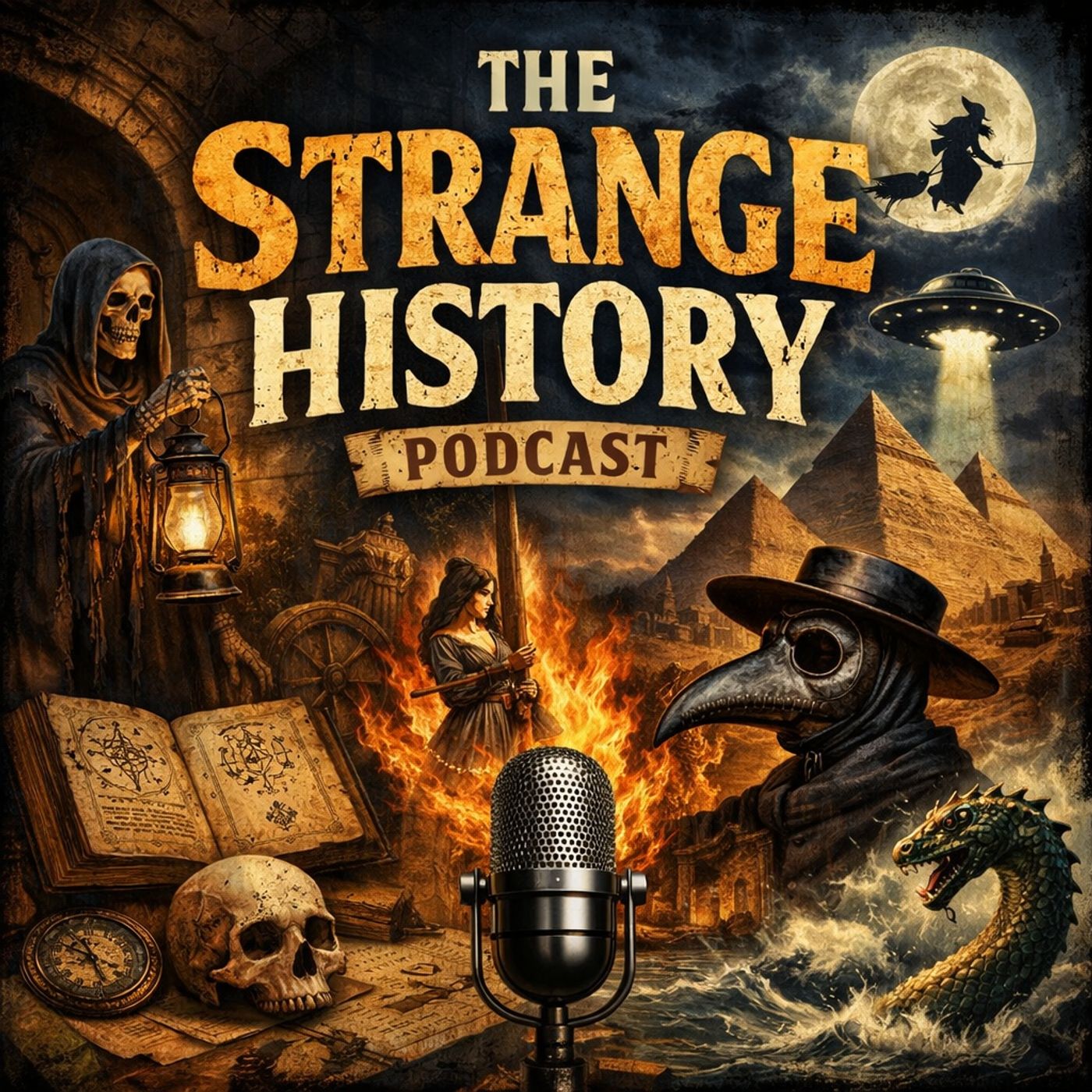
The Great New England Vampire Panic: How Tuberculosis Sparked a Supernatural Scare
Tonight's Episode
In this spine-tingling episode, we uncover the bizarre yet true story of the Great New England Vampire Panic. From the infamous case of Mercy Brown in Rhode Island to the eerie vampire graves of Griswold and Jewett City, we explore how a deadly tuberculosis outbreak fueled supernatural hysteria across 19th-century New England. Learn how families dug up their deceased loved ones, burned organs, and even drank the ashes—all in a desperate bid to stop a supposed undead menace. Plus, we dive into the science behind tuberculosis, the development of the first vaccine, and how medical advancements finally put an end to the region’s most chilling mass hysteria. Tune in for a fascinating mix of history, folklore, and dark humor!Become a supporter of this podcast: https://www.spreaker.com/podcast/the-strange-history-podcast--5773362/support.
🎧 The Strange History Podcast Love bizarre true stories, forgotten scandals, and history’s most unhinged moments?
Submit your ideas for The Strange History Podcast
Follow The Strange History Podcast wherever you listen and never miss an episode. 🔗 Listen & Subscribe:
Apple Podcasts
Spotify
iHeartRadio
Audible
New episodes regularly. History gets weird here.
Welcome to the Strange History Podcast. Buckle up, ladies and gentlemen, put on a turtleneck and grab some garlic. We are about to talk about vampires in New England. Now. I don't know about you, but I find the Victorian era of history the most interesting. The world was on the cusp of technology advances, but US humans were still gripping superstition and religious beliefs when it came to crisis. In the dark and dreary days of the late nineteenth century, Rhode Island, a state better known for its quah hogs and contentious tavern debates, became the unlikely epicenter of a vampire panic that left its citizens aghast, bewildered, and in at least one case, covered in an unfortunate amount of exhumed bodily fluids.
It all stemmed from a most peculiar epidemic. To fully appreciate the sheer absurdity of Rhode Island's vampire panic, one must first understand the grip of tuberculosis, or, as it was then ominously known, consumption. This disease, much like the overly persistent neighbor who just won't take a hint, made itself at home. In many Victorian households, it would steal in quietly draining its victims of vitality, leaving them gaunt, pale, and coughing up blood in a manner that suggested Gothic poetry rather than good health.
Medical science being somewhat akin to educated guesswork at the time, many folks saw a more supernatural explanation for their woes. The conclusion, obviously, their dead relatives, who had been exhumed for the sake of spectral justice, were rising from the grave and siphoning the life force from their kin. The most famous case to come out of Rhode Island's vampiric hullabaloo was that of Mercy Lena Brown of Exeter, a young woman who, much like her mother and sister before her, succumbed to tuberculosis in eighteen ninety two.
Her brother Edwin, having the unfortunate luck of still being alive, was suffering from the same wasting disease, and the good townsfolk decided that science had failed them. One doesn't simply let one's brother waste away while doing nothing, and by doing nothing they meant digging up corpses to check if they were vampires, and so, led by a collection of local minds more influenced by folklore than formal education, the good people of Exeter exhumed the Brown family. The mother and sister were appropriately decomposed, but Mercy, having been buried in the cold winter months, was remarkably well preserved.
This was all the proof they needed, never mind that refrigeration had yet to become a household staple. She must be a vampire. The most unpleasant remedy. Believing her to be the culprit of Edwin's illness, the townspeople removed Mercy's heart and liver, burned them to ashes, and then mixed the remains into a tincture. This concoction, in the spirit of dubious medical treatments, was promptly fed to Edwin in the hopes of curing his affliction. Shockingly, drinking the charred remains of one's deceased sister did not, in fact serve as an effective cure for tuberculosis, and Edwin passed away shortly thereafter.
The town, however, considered this a noble effort. You can't say they didn't try. Rhode Island was not the only New England location to suffer from a bout of post mortem paranoia. In Griswold, Connecticut, an unassuming colonial graveyard revealed yet another chapter of the region's vampire panic. In the nineteen nineties, a group of children playing near a gravel pit stumbled upon a collection of human remains, leading to a full archaeological investigation. The most peculiar discovery was a man who had been exhumed and reburied in the nineteenth century.
His bones had been deliberately rearranged into a skull and crossbones pattern, a common practice to prevent suspected vampires from rising. The man, later identified as JB, was likely a tuberculosis victim, and his reburial suggested that his frightened neighbors thought him responsible for the continued afflictions in their community. Just a short ride from Griswold, the town of Jewett City, Connecticut, saw its own vampire panic. In the eighteen fifties. The Ray family, much like the Browns of Rhode Island, were plagued by tuberculosis.
As several members of the family wasted away, the remaining townspeople decided that their departed relatives must be the cause. In a bid to put an end to the supernatural menace. The bodies of the deceased Ray family members were exhumed and burned. This drastic measure was believed to prevent further deaths, though in hindsight one could argue that proper quarantine and medical care might have been a slightly more effective approach. Then we move on to the tragic tale of Lina and her brother. Another chilling case of New England's vampire hysteria revolves around a young woman named Lina and her devoted but desperate brother.
After Lina succumbed to tuberculosis, her brother, convinced that she was draining his life from beyond the grave, participated in one of the most unsettling remedies of the era. Her body was exhumed, her heart removed and burned, and in an act of macabre desperation, he consumed the ashes, hoping it would break the vampire's hold over him. As one might expect, consuming cremated remains did not miraculously restore his health, and he succumbed to tuberculosis. Nonetheless, the story serves as a particularly gruesome example of the extent to which people would go in their fight against an invisible foe they barely understood.
Let's dive into the broad New England panic. Rhode Island, Connecticut and other parts of New England were rife with tales of exhumed bodies, desecrated graves, and one imagines more than a few cases of people awkwardly realizing they had just dug up their beloved aunt Mildred for no good reason. The idea of the New England vampire became part of regional lore, distinct from the suave cape wearing European variety. These were not charismatic aristocrats with hypnotic gazes, but rather sad, emaciated family members who had the audacity to continue dying.
Inconveniently, they were creatures of grief and fear, fueled by a medical crisis no one understood and a cultural inclination towards the supernatural. The vaccine that changed everything. While the idea of vampires as a cause of tuberculosis was put to rest, along with quite a few exhumed corpses, it wasn't until the twentieth century that an actual scientific solution emerged. In nineteen twenty one, French bacteriologists Albert Calmet and Camille Gherant developed the Bacillis calmet Geren vaccine, the first and only vaccine for tuberculosis.
Though its effectiveness varies by region, it became widely used in countries with high TB prevalence, significantly reducing the spread of the disease. By the mid twentieth century, improved public health measures, antibiotics like streptomycin, and widespread vaccination rendered tuberculosis far less of a mysterious and terrifying scourge. It turns out that science, not exhumation and organ burning, was the real hero of the story the end of an era.
As germ theory took hold and tuberculosis became less mysterious and more preventable, the vamp pyre panic faded into the history books, where it remains today as one of New England's strangest moments of mass hysteria. Rhode Island, Connecticut, and the rest of New England, having recovered from their brief flirtation with exhumation as medicine, went on to contribute much more sensibly to American culture clam cakes, for instance. And so, dear reader, let this be a lesson to us all. When faced with a strange affliction.
Perhaps consult a doctor before digging up Grandma. It may save you from a great deal of trouble and quite a bit of unnecessary grave digging. This has been another weird episode of Strange History. If you like this episode, spread the word, Tell your friends, family, and co workers, and promise them you will not dig them up if they die from a weird affliction. Subscribe and review. It's all appreciated and helps get the word out about this odd podcast. If not, we speak into the void, but no we av fun going through the strangest of our history.
 Apple Podcasts
 Castbox
 Castro
 Goodpods
 Moon FM
 Overcast
 Pocket Casts
 Podbean
 Podcast Addict
 Podcast Republic
 Spotify