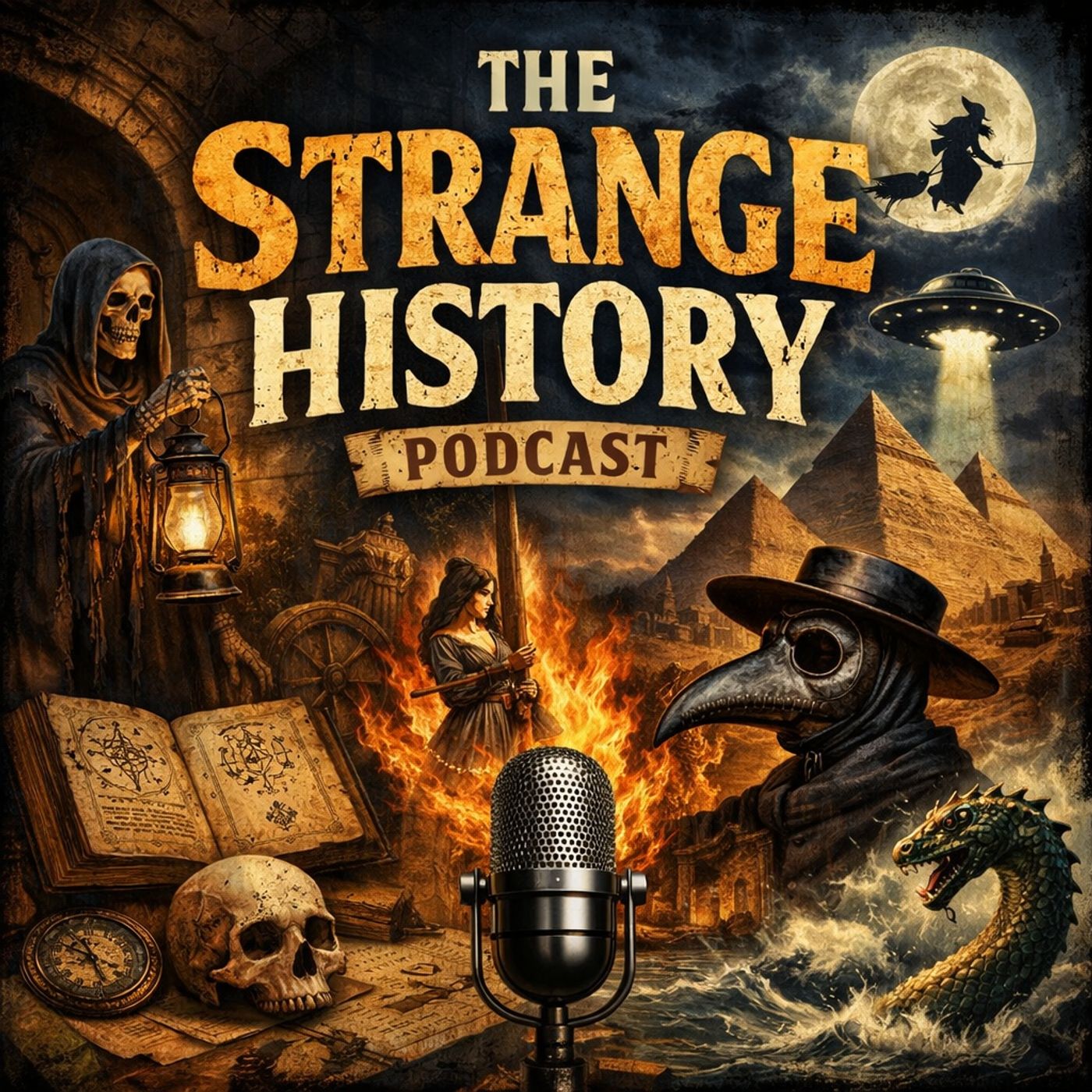
History’s Strangest Discoveries: What We Found Buried Will Shock You
Tonight's Episode
In this chilling and fascinating episode of The Strange History Podcast, we uncover 10 more bizarre archaeological discoveries that challenge everything we think we know about the past. From human bone instruments and ancient prosthetics to mysterious mummies, obsidian mirrors, and unexplained skulls, this episode dives deep into the strange, unsettling, and unexplained side of archaeology. Perfect for fans of ancient mysteries, weird history, and unexplained discoveries, this storytelling-driven episode blends real science with eerie intrigue.Become a supporter of this podcast: https://www.spreaker.com/podcast/the-strange-history-podcast--5773362/support.
🎧 The Strange History Podcast Love bizarre true stories, forgotten scandals, and history’s most unhinged moments?
Submit your ideas for The Strange History Podcast
Follow The Strange History Podcast wherever you listen and never miss an episode. 🔗 Listen & Subscribe:
Apple Podcasts
Spotify
iHeartRadio
Audible
New episodes regularly. History gets weird here.
Speaker 1: Dear listener, just when you think the past has revealed all its secrets, it quietly reminds you that we've barely scratched the surface, Because for every polished artifact behind museum glass, there are hundreds more buried beneath our feet, objects, skeletons, and stories that feel less like history and more like glitches in reality. Tonight we dig deeper. We begin with a sound, one that hasn't been heard in nearly two thousand years. In the ruins of ancient Rome, archaeologists uncovered a set of small, eerie instruments known as Roman bone whistles, crafted from human bones, yes, human bones.
Speaker 1: These objects blur the line between music and ritual. Some researchers believe they were used in ceremonies, possibly even funerary rites, where the boundary between the living and the dead felt dangerously thin. Imagine standing in the dark, hearing a whistle and knowing exactly what it was made from. From sound to silence, we moved to the desert where one of the oldest garments ever discovered still exists, the Tarkhan dress, found in Egypt and dating back over five thousand years. It's not just a piece of clothing.
Speaker 1: It's a moment frozen in time, carefully woven linen shaped to fit a human body, worn by someone who lived, moved, and existed in a world we can barely comprehend. Clothing is intimate. It carries the shape of a person long after they're gone. Now, let's talk about something even more unsettling. In Sweden, archaeologists uncovered a mass grave where skeletons were arranged in a deliberate, almost staged manner, some appearing to be holding hands, known as the Canal Jordan. This site includes skulls mounted on stakes, some with signs of trauma, others placed with eerie precision.
Speaker 1: It raises uncomfortable questions. Was this ritual punishment, a message or something we no longer have the language to understand. And then there are the shoes in Armenia. Preserved in a cave for over five thousand, five hundred years, A single leather shoe was discovered, perfectly intact the arena. One shoe still holds its shape, its laces, even traces of grass stuffed inside to keep the wear or warm. It's oddly relatable across thousands of years, across entirely different worlds. Someone dealt with cold feet the exact same way you would.
Speaker 1: But archaeology doesn't just reveal objects, it reveals mysteries that shouldn't exist. Take the Bagdad battery, a clay jar containing a copper cylinder and iron rod. Some believe it could have generated a small electric current over two thousand years ago electricity in the ancient world. It's debated, controversial, and still unresolved, but the possibility alone is enough to make you wonder how many discoveries were made and lost. Then we come to something that feels almost modern in its horror, ancient prosthetics.
Speaker 1: In Egypt, archaeologists discovered a wooden and leather prosthetic toe attached to a mummy, and not just decorative, it shows signs of wear, meaning it was used in life. Someone lost a part of themselves and engineered a way to keep walking. It's a quiet, powerful reminder that innovation doesn't belong to the modern world. Now, picture this a room filled with mirrors, except these mirrors are not made of glass. They're made of polished obsidian. In ancient meso America, these dark reflective surfaces were believed to be portals, tools for divination, or even gateways to other realms.
Speaker 1: To stare into one was not just to see your reflection, but possibly something staring back. And then there are the bodies that refuse to decay. The tearing basin mummies are some of the most eerily preserved humans ever discovered, with intact hair, clothing, and even facial features. They look less like ancient remains and more like people who simply fell asleep thousands of years ago. Their origins remain mysterious, their presence unsettling, as if time itself forgot to move forward. But perhaps one of the strangest discoveries comes from something tiny fingerprints.
Speaker 1: Ancient pottery often contains the fingerprints of the people who made them, preserved in clay, hardened by fire, and carried across millennia. It's the closest thing we have to shaking hands with the past, a direct physical connection to someone whose name we will never know. And finally we arrive at a question that refuses to go away. Across multiple continents, archaeologists have discovered skulls with elongated shapes far beyond what would occur naturally. Some are the result of intentional cranial deformation, a cultural practice, but others don't quite match known methods.
Speaker 1: They challenge what we think we understand about ancient societies, identity, and even biology itself. And now, dear listener, a quick word from tonight's sponsor.
Speaker 2: Are you tired of your house feeling too normal? Introducing historically accurate hauntings? That's right. Why settle for a generic ghost when you can have a fully researched, period correct apparition roaming your home. Choose from Viking spirits, Victorian children, or a mildly annoyed Roman tax collector who just follows you around. Sign Each haunting comes with historically accurate complaints and at least one unexplained cold spot historically accurate hauntings, because if if you're going to be terrified, should at least be educational.
Speaker 1: As we close Tonight's journey, something becomes clear. Archaeology is not just about uncovering the past. It's about confronting it, the strange, the unsettling, the deeply human pieces of history that don't fit neatly into textbooks. Because the truth is, the past was never normal, and someday, when future archaeologists dig through what we leave behind, they may look at our lives our objects, our habits, our strange little routines, and wonder the same thing. We wonder now, what were they thinking?
Speaker 1: Sleep well, dear listener, and remember we are all just artifacts in progress.
Speaker 2: M bon Bon had
 Apple Podcasts
 Castbox
 Castro
 Goodpods
 Moon FM
 Overcast
 Pocket Casts
 Podbean
 Podcast Addict
 Podcast Republic
 Spotify