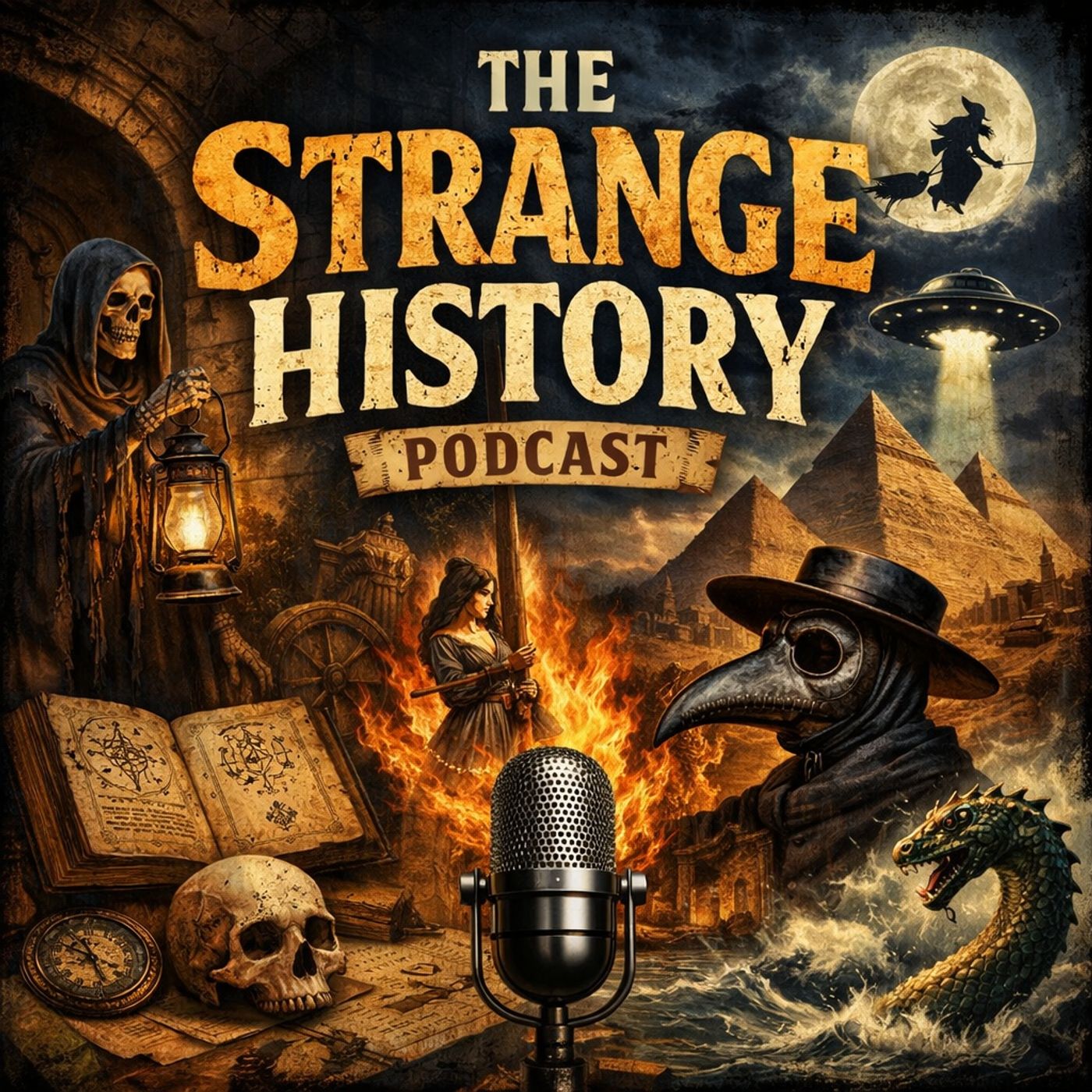
History Was Weird: 10 Archaeology Discoveries That Shouldn’t Exist
Tonight's Episode
Step into the strangest corners of human history in this immersive episode of The Strange History Podcast. From urine-powered Roman laundry and ancient analog computers to Viking cats, mummy medicine, and prehistoric chewing gum with preserved DNA, this episode explores the weirdest archaeological discoveries ever uncovered. Blending storytelling, humor, and real historical research, we uncover the bizarre truth about ancient civilizations and the shocking ways humans lived, healed, played, and survived. If you love unexplained history, ancient mysteries, and strange discoveries, this episode will change the way you see the past forever.Become a supporter of this podcast: https://www.spreaker.com/podcast/the-strange-history-podcast--5773362/support.
🎧 The Strange History Podcast Love bizarre true stories, forgotten scandals, and history’s most unhinged moments?
Submit your ideas for The Strange History Podcast
Follow The Strange History Podcast wherever you listen and never miss an episode. 🔗 Listen & Subscribe:
Apple Podcasts
Spotify
iHeartRadio
Audible
New episodes regularly. History gets weird here.
Speaker 1: Dear listener, tonight, we are not stepping into the polished version of history you learned in school. No neat timelines, no heroic statues, no tidy conclusions. Instead, we're peeling back the layers, the dirt, the bones, the fragments of pottery and forgotten lives to uncover something far stranger. Because archaeology, at its core is not just about discovering the past. It's about discovering just how bizarre humans have always been. And once you really start looking, it becomes impossible to unsee.
Speaker 1: Let's begin in the streets, no, actually not the streets of ancient Rome, a civilization known for engineering brilliance, sprawling empires, and vats of human urine, Yes, urine. Public collection pots were placed throughout Roman cities where citizens would casually contribute their donations. These were then sold to fullers, professional launderers, who stomped clothing in the ammonia rich liquid to clean it. There's something deeply humbling about knowing that beneath the grandeur of marble columns and aqueducts, someone's entire job was to stand ankle deep in fermented human waste, scrubbing tunics.
Speaker 1: Even more fascinating the Roman emperor of Vespasian taxed urine collection, leading to the famous phrase that money does not stink, except in this case it absolutely did. Now, let's shift from something revolting to something impossibly advanced. Pulled from a shipwreck off the coast of Greece, the Antikythera mechanism looked at first like a corroded lump of bronze, but inside, hidden for over two thousand years, was a system of intricate gears capable of predicting eclipses, tracking planetary motion, and modeling the cosmos.
Speaker 1: It is, by every reasonable definition, the world's first analog computer. And here's the unsettling part. Nothing like it appears again in the archaeological record for more than a thousand years. It's as if someone briefly unlocked a technological future and then the knowledge vanished into the sea. From machines to mythology, we travel north to the age of the Vikings, where life was harsh, cold, and surprisingly, feline cats were not just pets. They were sacred companions tied to the goddess Freya, who was said to ride a chariot pulled by them.
Speaker 1: Archaeological digs have uncovered cat remains buried with care, suggesting they were valued both spiritually and practically, keeping rodent populations down on long sea voyages. It paints a strange but comforting picture fearsome warriors sailing into battle, possibly pausing to scratch behind the ears of a very important ship cat. Meanwhile, in ancient Egypt, the journey didn't end with death, it simply changed location, and apparently boredom was still a concern in the afterlife. That's where the game Senate comes in.
Speaker 1: Boards have been found in tombs placed carefully beside the dead, suggesting that the Egyptians believed strategy, luck, and perhaps even a little competition would follow you into eternity. Imagine crossing into the afterlife only to immediately lose a board game to someone who's been practicing for three thousand years. But archaeology doesn't just uncover objects, it uncovers people. In Denmark, a piece of five thousand, seven hundred year old birch tar, once chewed like gum, was discovered with preserved human DNA.
Speaker 1: From that scientists reconstructed the face of a young woman who lived in the Stone Age. Her features, her ancestry, even traces of what she last ate. It's an eerie kind of time time travel where a casual, absent minded act chewing gum becomes a message across millennia, a reminder that someone lived, breathed, and existed just like you. And then there's Pompeii, frozen in time by the catastrophic eruption of Mount Vesuvius seventy nine AD. It offers one of the most detailed snapshots of ancient daily life ever discovered.
Speaker 1: And what does that snapshot reveal? Not just tragedy, but graffiti, crude jokes, insults, boasts, and very explicit messages etched into walls. It's strangely comforting. Across two thousand years, across empires and languages, humanity has remained remarkably consistent in its desire to write questionable things on public surfaces. Now, if that wasn't strange enough, let's move into medieval Europe, where medicine took a darker time. Powdered mummy known as Mumia became a sought after remedy ground from the preserved remains of ancient Egyptians.
Speaker 1: It was believed to cure ailments ranging from headaches to internal bleeding. Entire trade routes were built around the consumption of the dead. It's a chilling intersection of archaeology and desperation, where ancient bodies became modern medicine. Across the world. In what is now Turkey lies chatal Hooyuk, a city that defies everything we expect urban life to look like. There were no streets, no front doors, Homes were packed together, and people moved across rooftops, entering through holes in the ceiling.
Speaker 1: It was a dense, interconnected maze of human life, part community, part fortress, part architectural puzzle that still leaves archaeologists scratching their heads and speaking of massive undertakings. Few discoveries rival the sheer scale of China's terra Cotta army, thousands of life sized soldiers, each with unique facial features, expressions, and details, created to guard the tomb of Emperor Chin Chihuang in the afterlife. It's not just an army, it's a statement, a declaration that even in death, power must be protected, enforced, and perhaps feared.
Speaker 1: Finally, we arrive at one of the most unsettling practices ever discovered, trepidation. Ancient cultures across the world drilled holes into human skulls, possibly to relieve pressure, treat illness, or even release spirits, and against all odds, many patients survived. Their skulls show signs of healing, of boney, growth of life continuing after something that should have been fatal. It forces us to reconsider what ancient people knew and how much of it we've forgotten. And now, dear listener, a quick word from tonight's sponsor.
Speaker 2: Have you ever wished you could leave something behind for future archaeologists? But like cooler than pottery shards? Introducing bury Me premium time capsules that's right. For a small monthly fee, will professionally curate your weirdest belongings, your phone, your snack wrappers, your questionable Internet search history, and bury them in a certified archaeological grade vault. Future civilizations won't just study you, they'll judge you bury me, because nothing says legacy like confusing scientists.
Speaker 2: Five thousand years from now.
Speaker 1: As we come to the end of this journey, one thing becomes clear. The past is not a distant, polished story. It's messy, it's strange, it's deeply undeniably human, and every artifact, every skeleton, every piece of chewed gum is a whisper, a reminder that long before us, people lived lives just as complicated, just as curious, and just as weird, And maybe the strangest part of all is realizing that someday we will be the artifacts. So tonight, as you close your eyes, ask yourself what would they find and what would it say about you?
Speaker 1: Sleep well, dear listener, because history is watching
Speaker 2: The hidden
 Apple Podcasts
 Castbox
 Castro
 Goodpods
 Moon FM
 Overcast
 Pocket Casts
 Podbean
 Podcast Addict
 Podcast Republic
 Spotify