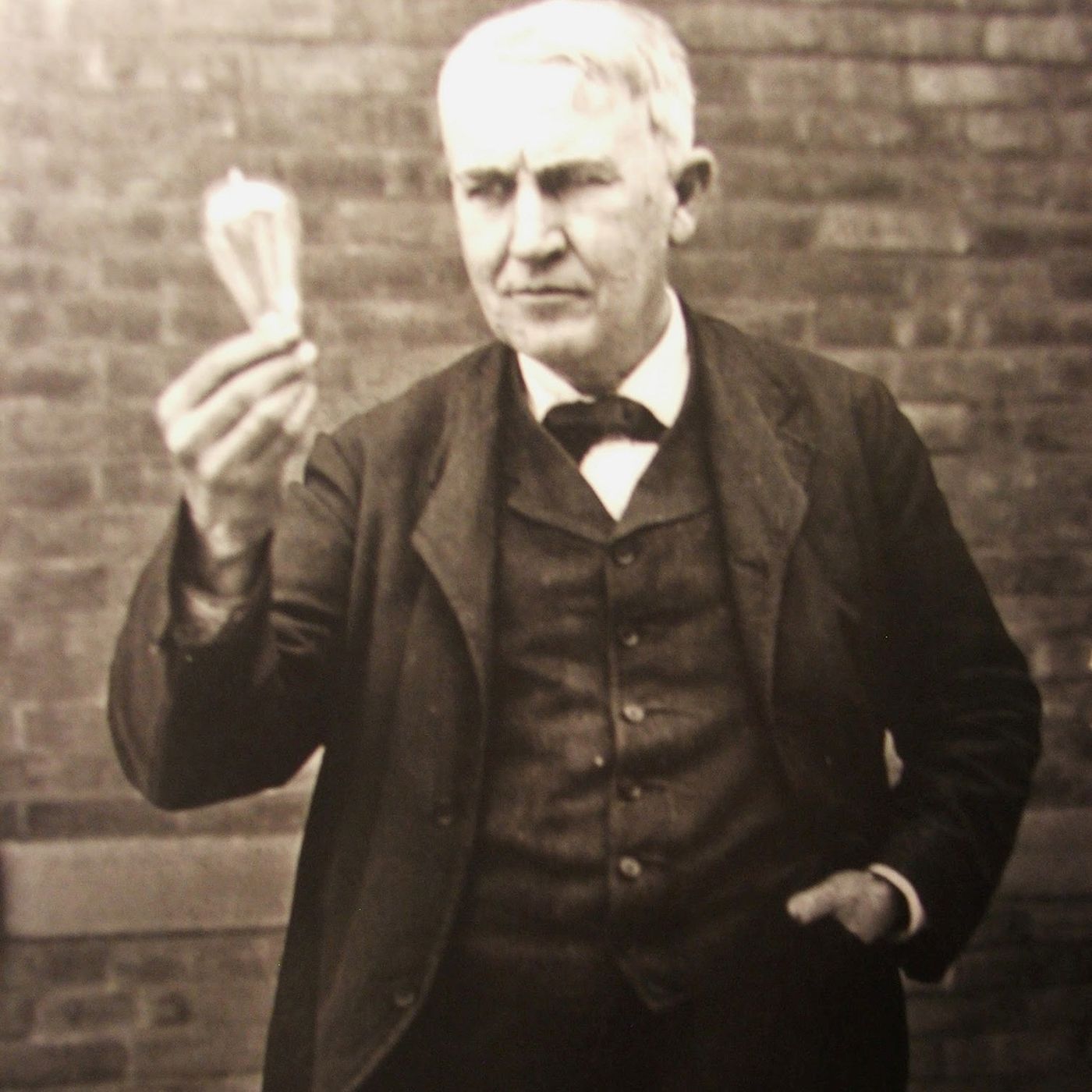
From the 1st Viral Cat Video to the Lightbulb, Thomas Edison Had a Shady Past!
Tonight's Episode
Discover the fascinating life and groundbreaking inventions of Thomas Edison, the prolific inventor known for bringing light to the world with the incandescent bulb, revolutionizing music with the phonograph, and shaping the entertainment industry through early motion pictures. Join us as we explore the genius and innovation behind 'The Wizard of Menlo Park'.Become a supporter of this podcast: https://www.spreaker.com/podcast/the-strange-history-podcast--5773362/support.
🎧 The Strange History Podcast Love bizarre true stories, forgotten scandals, and history’s most unhinged moments?
Submit your ideas for The Strange History Podcast
Follow The Strange History Podcast wherever you listen and never miss an episode. 🔗 Listen & Subscribe:
Apple Podcasts
Spotify
iHeartRadio
Audible
New episodes regularly. History gets weird here.
Welcome to Strange History. If you're anything like me, you can quickly fall down the rabbit hole of funny cat videos on TikTok, Instagram or YouTube. But did you know Thomas Edison created the very first cat video in eighteen ninety four. It was a very short film titled Boxing Cats or Professor Wellington's Boxing Cats. In this film, Edison's team stage a humorous scene where they filmed two cats boxing each other inside of a small ring. It was a short comedic piece showcasing the cats playfully swatting at each other while wearing tiny boxing gloves.
This early example of animal themed entertainment in the film history is indeed a precursor to the Internet's fascination with cat videos. Thomas Edison himself has a very interesting history. He was born Thomas Alva Edison on February eleventh, eighteen forty seven, and the small town of Milan, Ohio. His early years were far from glamorous. Raised in a modest family, young Edison had a challenging starts life. First, let's talk about his education, or his lack thereof. Edison had limited formal schooling.
He intended school briefly, but he was mostly homeschooled by his mother and Nancy Edison. His early education laid the foundation for his lifelong love of learning and insatiable curiosity. Edison's childhood was also marked by adversity. At a young age, he fell seriously ill, possibly with scarlet fever or a middle ear infection. This left him with a lifelong hearing impairment. This made traditional classroom learning difficult for him, but ultimately played a role in shaping his unique path.
Despite his challenges, young Edison demonstrated an entrepreneurial spirit. He began selling candy and newspapers on trains and at the train stations, showcasing a talent for business. From a very early age. Edison was, by all accounts, a self taught genius. He devoured books and conducted numerous experiments on his own. Some reports even claimed that he read every book at his local library, a testament to his thirst for knowledge. At the age of fifteen, Edison took a major step in his journey.
He became a telegraph operator, a profession that would shape his future. Working with telegraph equipment exposed him to the world of electrical systems and technology, a field he would later revolutionize In eighteen sixty nine, at the age of twenty two, Edison made a significant move. He relocated to the bustling city of New York, eager to pursue a career as an inventor. This move marked the beginning of his transformation from a young, self educated entrepreneur into a prolific inventor. Edison's early inventions were focused on improving telegraph equipment.
One of his early successes was the invention of the stock ticker machine. This invention not only earned him recognition, but also provided the financial backing for his future experiments. In eighteen seventy six, Edison took a pivotal step in his career by establishing his legendary Menlo Park Laboratory in New Jersey, which was also referred to as the Invention Factory. It was here that he would develop some of the most groundbreaking inventions, including the phonograph and the incandescent light bulb.
Let's review some of the things invented by Edison. He was a prolific inventor with over a thousand patents to his name. He invented that incandescent light bulb. His design used a filament and a vacuum to produce light, making it commercially viable as a source of artificial light. He also invented the photograph, revolutionizing the world of music and audio recording. It could record and playback sound, marking the beginning of audio recording industry. So thank you Edison, because podcasting, I'm sure it would be here, but you are basically the start of audio recording.
Motion pictures. Edison played a significant role in the development of motion pictures. He created the kindoscope, an early motion picture viewer, and the graph and early motion picture camera. He also invented the carbon microphone, which was a crucial invention for early telecommunications. It greatly improved the quality and clarity of telephone communication. Electrical power distribution. Edison developed a system for electric power distribution, including the construction of power plants, electrical generators, and the establishment of the first electrical distribution network in New York City.
Storage batteries. Edison improved storage batteries known as nickel iron battery and was used for various applications including electric cars way back then. The dictation machine. Edison invented the Edison dictation machine, which allowed for voice recording and transcription improving office efficiency. Fluoroscopy, Edison worked on the development of fluoroscopy, a technique for viewing internal body structures using X rays. His work in this area contribute to the field of medical imaging. Cement manufacturing, Edison developed a process for cement manufacturing that improved the quality efficiency of cement production.
He also invented the magnetic ore separator. Edison's magnetic ore separator was used in the mining industry to separate iron ore from other minerals, making mining more efficient. He also invented telegraph devices. Before his major inventions, Edison worked on several improvements to telegraphy, including the automatic telegraph system. He created an electric pen. The electric pen was an early copy machine that used a perforated stencil to create duplicates of handwritten documents. Edison invented a vote recording machine that was intended to automate the voting process, although it was not widely adopted.
These are just some of the many inventions credited to Thomas Edison. His work spanned various fields, including electricity, sound recording, and telecommunications, and his inventions had a pro found impact on modern technology and society. Edison's early life was marked by adversity, self education, and relentless drive to understanding create His journey from a modest beginning in rural Ohio to becoming a global icon of innovation is a testament to the power of curiosity, determination, and unyielding pursuit of knowledge.
But rarely do we have a great man in history that does not have a shady side to his past. Edison's treatment of his employees, particularly in his laboratories, has been criticized. Penny was known for working them long hours, often with little regard for their well being. Some of his employees faced harsh conditions and a lack of job security. Edison was involved in experiments that used animals, including dogs and cats, for various purposes, such as testing electrical currents. His involvement in electrocuting animals as part of developing the electrical chair is particularly controversial.
Edison and was involved in the War of the Currents, a bitter rivalry with inventor George Westinghouse over the adoption of the electrical system. Edison promoted direct current DC while Westinghouse advocated for alternating current ACE. Edison engaged in a smear campaign against AC, including publicly electrocuting animals using ac power to create fear and doubt about its safety. Edison was involved in numerous patent disputes throughout his career. Some critics argued that he used a patent system to cifle competition and secure his position in the industry.
His legal battles with other inventors, including Nikola Tesla, were protracted and often contentious. Edison had a large team of assistance and engineers who played crucial roles in his inventions. Some argue that he didn't always give proper credit to these individuals for their contributions. He was also known for his determination to seed sometime at the expense of ethical considerations. For example, during his work on the light bulb, he conducted could countless experiments putting the use of hazardous materials without adequate safety precautions.
Edison's views on intellectual property were also controversial. He believed in strict patent enforcements and once famously said genius is one percent inspiration ninety nine percent perspiration. Some argue that he was more interested in commercial success than the free sharing of knowledge. It's important to view historical figures like Edison in a balanced light. Recognizing their contributions to science and technology alongside their flaws and controversies. While Edison's work undeniably transformed the world, his methods and actions were not always without criticism.
That wraps up today's episode of Strange History. Join us next time as we continue to explore the lives and achievements of history's greatest inventors. Thank you for tuning in.
 Apple Podcasts
 Castbox
 Castro
 Goodpods
 Moon FM
 Overcast
 Pocket Casts
 Podbean
 Podcast Addict
 Podcast Republic
 Spotify