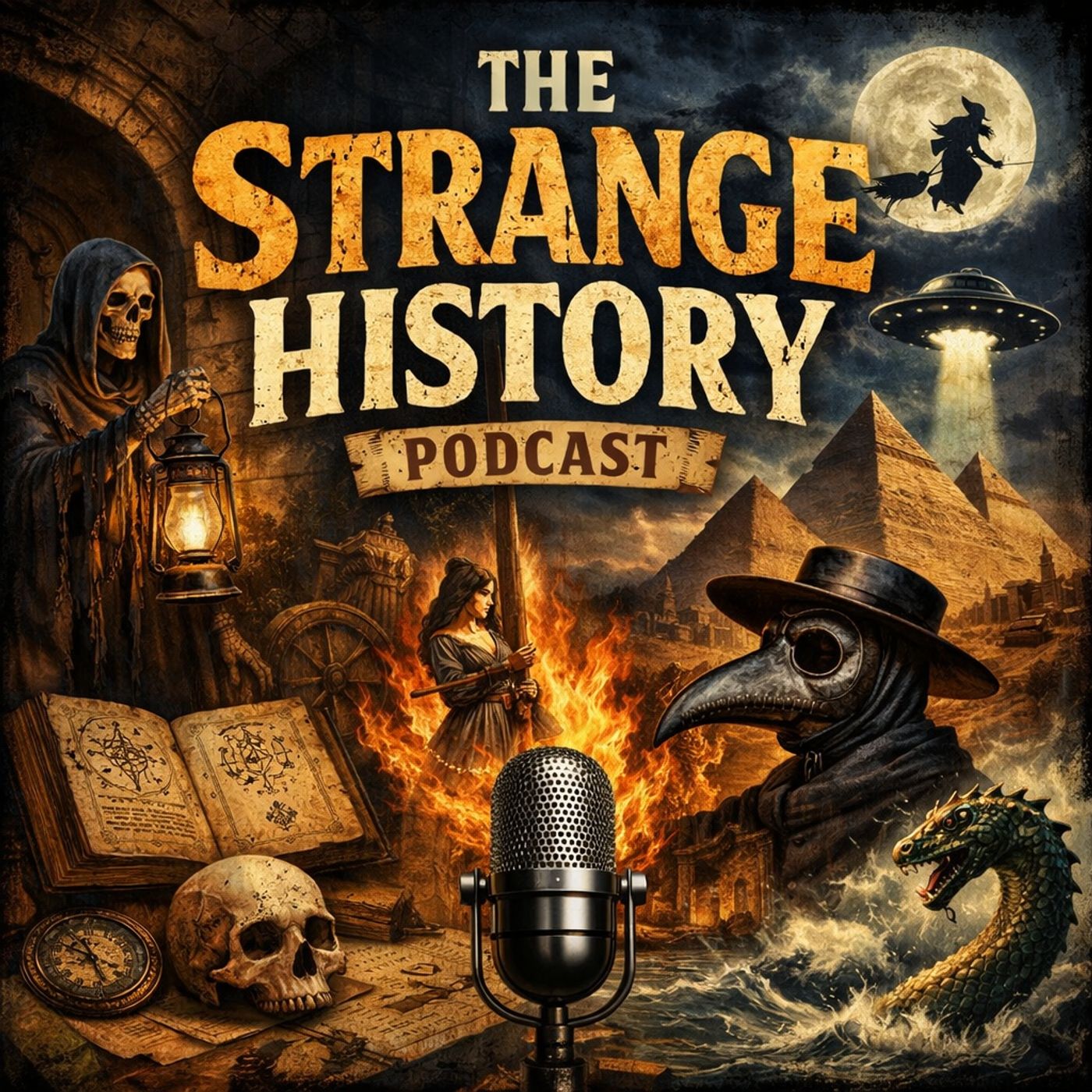
The Nuckelavee: Scotland's Skinless Sea Monster | The Darkest Legend of Orkney Folklore
Tonight's Episode
What if Scotland's most terrifying monster wasn't a dragon or a ghost... but a skinless creature blamed for disease, famine, storms, and death?In this chilling episode of The Strange History Podcast, Amy continues the Tonight's Tale Was Once Told as Truth series by exploring one of the darkest and least-known legends in all of European folklore—the Nuckelavee, a horrifying creature from Scotland's remote Orkney Islands.Described as a grotesque fusion of horse and man with no skin covering its body, the Nuckelavee was feared for centuries as the bringer of plague, failed harvests, dying livestock, poisoned water, and devastating storms. Islanders believed its foul breath spread disease wherever it traveled, and that only fresh running water could stop its relentless pursuit.But where did this terrifying legend come from? Was the Nuckelavee inspired by Viking mythology, ancient Norse beliefs, deadly livestock epidemics, harmful algal blooms, violent North Atlantic storms, or the harsh realities of life on Scotland's isolated northern islands? Join Amy as she uncovers the remarkable history behind the myth, explores Orkney's Viking past, examines the work of folklorist Walter Traill Dennison, and reveals how ordinary people transformed fear and uncertainty into one of Britain's most unforgettable monsters.If you enjoy strange history, Scottish folklore, Norse mythology, maritime legends, medieval history, haunted Britain, mysterious creatures, Celtic traditions, and the true stories hidden beneath ancient myths, this is an episode you won't want to miss.Tonight's Tale Was Once Told as Truth...Become a supporter of this podcast: https://www.spreaker.com/podcast/the-strange-history-podcast--5773362/support.
🎧 The Strange History Podcast Love bizarre true stories, forgotten scandals, and history’s most unhinged moments?
Submit your ideas for The Strange History Podcast
Follow The Strange History Podcast wherever you listen and never miss an episode. 🔗 Listen & Subscribe:
Apple Podcasts
Spotify
iHeartRadio
Audible
New episodes regularly. History gets weird here.
Speaker 1: The horse should have been the first warning, not because there was anything unusual about seeing a horse standing beside a lonely road in the Orkney Islands. Horses had worked these windswept landscapes for centuries, pulling carts filled with peat, carrying fishermen home from distant harbors, and patiently waiting while shepherds gathered their flocks beneath vast gray skies. They were as much a part of island life as the sea itself. Yet there was something deeply unsettling about this particular animal.
Speaker 1: It stood perfectly still on a narrow stretch of coastal road overlooking the North Sea, its dark silhouette illuminated only by the pale light of a full moon. Struggling to break through racing clouds. It neither grazed nor stamped its hoofs against the cold ground. It simply watched the empty road ahead, as though patiently waiting for someone to arrive. The wind carried the smell of salt water and damp kelp across the cliffs, but beneath those familiar scents lingered another odor that did not belong.
Speaker 1: It was the unmistakable smell of decay, like rotting seaweed mixed with stagnant marsh water and something far older, a scent that seemed to crawl into the lungs and settle there. An elderly fisherman returning home from checking his lobster pots slowed his pace, almost without realizing it. His lantern swayed gently in his trembling hand, casting long shadows across the road, while every story he had ever heard as a child quietly returned to the front of his mind. There were places on these islands where sensible people did not linger after sunset.
Speaker 1: There were roads that belonged to the night, and there were creatures that no honest islander wished to meet. Beneath the moon, he called out softly, assuming the horse had wandered away from a nearby croft. His voice disappeared into the wind without receiving so much as an acknowledging twitch of the animal's ears. Curious more than frightened, he stepped closer, raising the lantern until its warm golden light pushed back the darkness. At first, the horse remained little more than a silhouette, but with every cautious step, another impossible detail emerged from the shadows.
Speaker 1: The animal's body seemed strangely wet, its muscles glistening beneath the moonlight, as though it had only moments before climbed from the sea. Then the fisherman realized why the flesh looked so unusual. It wasn't covered by skin at all. Every muscle, tendon, and blood vessel lay completely exposed, rippling beneath the lantern light. In horrifying detail. Steam drifted slowly from its body despite the cold night air, and a single enormous eye rolled silently toward him, glowing with an unhealthy yellow light that reflected in the glass of the lantern.
Speaker 1: His breath caught in his throat. Before he could convince himself he was imagining things, the creature shifted ever so slightly, revealing something far worse than the horse itself. Rising directly from the middle of its back was the upper body of what appeared to be a man. Although no living person had ever looked like this, the human torso and the horse were fused together into one impossible creature. Its arms hung unnaturally long, nearly scraping the ground. Its head seemed grotesquely oversized, lolling from side to side upon a thick neck, where dark blood pulsed visibly beneath raw muscle.
Speaker 1: A single eye far too large for its face, stared directly into the old fisherman's soul, while a mouth filled with enormous teeth slowly opened into something resembling a smile. Thick black breath escaped its lips, carrying with it the stench of disease, decay, and death itself. The fisherman wanted to run. Every instinct screamed at him to flee, yet terror rooted him to the road as surely as if his boots had become part of the stone beneath his feet. Then the creature spoke. Its voice did not sound human.
Speaker 1: It rolled across the cliffs like waves, crashing against jagged rocks, deep enough to seem as though it came from somewhere beneath the earth itself. It did not shout or roar. It whispered, yet every word echoed through the darkness with impossible clarity, as though the wind itself carried its voice from one end of the island to the other. The old fisherman later claimed he could never remember exactly what the creature had said. He only remembered understanding it perfectly in that terrible moment.
Speaker 1: It spoke of storms still waiting beyond the horizon. It spoke of live stock that would soon sicken without explanation, of children who would awaken with fever before another moon had passed. Most chilling of all, it spoke the fisherman's own name, as though it had known him his entire life. The lantern slipped from his trembling hand and shattered against the stones, plunging the lonely road into darkness. When he finally gathered the courage to look again, the creature had vanished completely.
Speaker 1: Only the smell remained lingering upon the sea breeze, long after dawn broke over the Orkney Cliffs. Dear listener, welcome back to the Strange History Podcast. I'm Amy, and tonight we continue our special series. Tonight's tale was once told as truth. History remembers kings and queens. It remembers battles that changed nations, inventions that transformed civilizations, and explorers who sailed into the unknown. Yet history also belongs to ordinary people whose names have long since been forgotten.
Speaker 1: Farmers who watched storm destroy an entire year's harvest. Fishermen who disappeared beneath cold northern seas without leaving behind a single piece of wreckage. Mothers who cared for children stricken with mysterious illnesses that no physician could explain. These were people who lived in a world where nature often seemed both beautiful and deeply terrifying, and when disaster arrived without warning, they searched desperately for answers. Sometimes those answers came from religion, sometimes they came from experience, and sometimes they came wrapped in stories so unforgettable that centuries later we still whisper them beside fireplaces and record them in books.
Speaker 1: Tonight, our journey takes us farther north than any tale we've explored so far, to Scotland's Orkney Islands, where the North Sea and the Atlantic Ocean collide against rugged cliffs shaped by wind, salt and time. These islands are breathtakingly beautiful, but beauty has always carried a price. Here, winters are long, storms arrive suddenly, crops struggle against poor soil, and the sea that provides life can claim it just as quickly for generations. Families living upon these isolated islands believed that one terrible creature wandered the coastline after dark.
Speaker 1: Unlike dragons or giants, this monster did not guard treasure, rescue maidens, or demand heroic battles. It brought something far more familiar. Disease, drought, failed harvests, sick livestock, rotting crops, plagues that swept silently across entire communities. Every unexplained hardship carried the same whispered explanation. Somewhere out upon the moors or walking beside the lonely shoreline, the knuckle of v had been seen. Unlike many mythical creatures whose appearance changes from one storyteller to another, descriptions of the knuckle Avy remained remarkably consistent for centuries.
Speaker 1: It was all always skinless, always a grotesque combination of man and horse fuse together into one impossible body, always carrying with it the smell of death and the promise of suffering. Parents warned children never to wander too close to lonely beaches after sunset, because the creature was said to emerge from the sea itself. Fishermen crossed themselves before setting sail. Farmers whispered prayers whenever disease spread unexpectedly through their animals. Even adults who laughed at many superstitions often admitted there were certain roads they preferred not to travel alone after dark.
Speaker 1: Whether they truly believed the monster existed hardly mattered. The fear itself had become part of everyday life, and that raises the question that lies at the heart of Tonight's tale. Why would an entire island community imagine one of the most horrifying creatures in all of European folklore? What kind of world creates a monster with no skin, one whose very breath spreads sickness across the land. The answer, as we'll discover, lies not only in folklore, but in Viking history, harsh island life, ancient Norse beliefs, deadly epidemics, and the unforgiving power of the sea itself.
Speaker 1: Tonight's tale was once told as truth, and before the night is over, I think you'll understand exactly why. Dear listener, If you have never stood on the Orkney Islands, it can be difficult to understand why so many extraordinary stories were born there. Scattered just off the northern coast of Mainland Scotland, the islands appear almost peaceful, in photographs, rolling green fields stretched toward dramatic sea cliffs where thousands of seabirds nest every spring. Ancient stone circles rise quietly from the landscape, standing watch over the same hills they have overlooked for thousands of years.
Speaker 1: Small fishing villages hug sheltered harbors, wear colorful boats, bob gently against wooden piers, and on a calm summer evening, it is easy to imagine Orkney as one of the most beautiful places in Britain. Yet photographs rarely capture the force of the wind that seems never to stop blowing, the sudden fog that can swallow an entire coastline in minutes, or the violent winter storms that have shaped life here since the first people arrived. For those who called these islands home centuries ago, nature was never simply scenery.
Speaker 1: It was a constant companion, capable of providing everything they needed to survive or taking it all away before sunrise. The sea fed families through fishing, yet it also swallowed fathers, sons, and brothers with frightening regularity. Thin soil produced crops only through relentless labor and a single season, and of bad weather. Could leave entire communities wondering how they would survive the coming winter. It was a landscape that rewarded respect while punishing arrogance, and over generations, its people learned to explain its mysteries through stories that were every bit as wild as the land itself.
Speaker 1: Long before Scotland ruled these islands, Orkney belonged to the Norse world. Beginning in the late eighth century, Viking ships crossed the cold northern waters and established settlements that would endure for centuries. They did not merely conquer the islands, they transformed them. The language, customs, place names, and beliefs of the Norse settlers blended with older traditions already rooted in the landscape, creating a culture unlike anywhere else in Britain. Even today, visitors quickly noticed names that echo Old Norse rather than Gaelic, reminders that Orkney's history has always looked as much towards Scandinavia as it has towards Scotland.
Speaker 1: Those Viking settlers carried with them stories of trolls lurking in lonely valleys, sea spirits capable of destroying entire fleets, shape shifting creatures that blurred the line between human and beast, and supernatural beings that punish those who ignored the unwritten rules of nature. In Norse mythology, the world was already crowded with invisible forces. Giants lived beyond the mountains, Serpents slept beneath the oceans. Gods walked among ordinary people in disguise. To newcomers settling isolated islands surrounded by unpredictable seas, it required very little imagination to believe another terrifying creature might also exist somewhere beyond the next hill or hidden within the evening mist.
Speaker 1: Yet the Knuckle of Ee was unlike anything found in the traditional myths of mainland Scandinavia. Folklorists have puzzled over that fact for generations. While traces of Norse influence appear throughout the creature's story, the monster itself seems uniquely Orcadian, shaped by the particular fears of island life, rather than copied from older Viking legends. That uniqueness makes the Knuckle of Ee especially valuable to historians, because it offers a rare glimpse into the collective imagination of a small, isolated community.
Speaker 1: Every culture creates monsters, but those monsters almost always reveal what people fear most. Desert civilizations imagine spirits of endless sand and scorching heat. Mountain communities tell stories of creatures hidden among the peaks. Forest cultures fear what waits beyond the trees. On Orkney, where survival depended upon healthy animals, successful harvests, and calm seas, the ultimate monster was one capable of destroying all three without warning. According to the oldest surviving folklore, the Knuckle of Ee rarely attacked people simply for oneing too close.
Speaker 1: That is one of the details that makes the legend so unsettling. It did not behave like a predator searching for prey. Instead, it spread suffering almost casually wherever it traveled. Crops withered in the fields, fresh water became contaminated, horses sickened without explanation, Cattle collapsed in their pastures. Epidemics swept through villages that had appeared perfectly healthy only days before. Fishermen complained that the creature's breath poisoned the sea itself, driving fish away from familiar waters and leaving families hungry.
Speaker 1: Some stories even claimed that seaweed gathered from beeches visited by the knuckaalavy caused mysterious illnesses among those who handled it. To modern ears, these claims sound fantastical, yet beneath each one lies a surprisingly familiar human experience. Imagine waking one morning to discover your healthiest cow suddenly unable to stand. A week later, your neighbor loses half his sheep. Soon afterward, children throughout the village develop fevers, while strange blights begin appearing across fields that had promised an abundant harvest only days earlier.
Speaker 1: Without knowledge of bacteria, viruses, parasites, or environmental toxins, how would you explain such disasters? If one misfortune followed another often enough, eventually they would begin to feel connected. The human mind has always searched for patterns, especially when confronted by fear. On Orkney, those patterns took the shape of a skinless monster walking silently through the night. One of the most intriguing details surrounding the knucklelavy is that, despite its terrifying power, it possessed a single weakness known to nearly every island child.
Speaker 1: Fresh running water, streams, rivers, and flowing burns formed an invisible barrier the creature could not cross. Parents reminded their children that if they ever encountered the knuckle Avy after dark, they should run toward the nearest stream without looking back. The monster might pursue them to the water's edge, but there it would stop, unable to continue the chase. At first glance, this seems like just another curious detail in an old folk tale, but historians have suggested something more practical, maybe hiding beneath the legend.
Speaker 1: Freshwater represented safety in countless ways. It sustained livestock, nourished crops, and provided clean drinking water in a world where stagnant pools often carried disease. Rivers also formed natural boundaries across the landscape, making them obvious landmarks when navigating unfamiliar ground after sunset. Whether or not anyone truly believed the knuckle Avy feared running water, the story encouraged people, especially children, to remember where fresh streams could always be found. Folklore often disguises practical survival lessons beneath layers of supernatural imagery, and this may be one of its finest examples.
Speaker 1: Perhaps the most disturbing aspect of the legend was the creature's appearance. Nearly every description insists that it had no skin whatsoever. Its muscles, veins, and sinews remained permanently exposed, glistening as though freshly flayed. Even experienced storytellers struggled to describe the horror of looking directly at it. Some said yellow blood pulsed visibly beneath its exposed flesh. Others claimed black smoke escaped from its nostrils whenever it breathed. The enormous head was often compared to that of a horse, while the human torso growing from its back possessed grotesquely oversized arms that dangled almost to the ground.
Speaker 1: Why imagine such an impossibly grotesque creature? Why remove its skin? The answer may lie not in fantasy, but in observation. Islanders were intimately familiar with dead livestock, butchered animals and whales, occasionally washing ashore in various stages of decomposition. Exposed muscle was not an abstract horror. It was something people genuinely encountered. By combining familiar images into one impossible being, storytellers created a monster that felt disturbingly real because every individual part of it already existed within their everyday experience.
Speaker 1: As strange as the knuckle of v appears, the creature never demanded treasure, sacrifices, or worship. It wanted only one thing, to remind human beings that nature could never be fully controlled, and perhaps that is why the legends survived for so many centuries. Every time disease returned to the islands, every time storms destroyed fishing fleets, every time families face another winter wondering whether enough food remain to see them through, someone inevitably whispered that the knuck Alavi had been seen again.
Speaker 1: And that brings us to one of the greatest mysteries surrounding this terrifying legend. What if the people of Orkney weren't describing a monster at all? What if they were giving a face to something they could not see. Every great legend begins with a question. Sometimes that question is simple. Why did a ship disappear without leaving behind so much as a splinter of wood? Why did healthy livestock suddenly collapse in the middle of a field. Why did an entire village become sick within the space of a few weeks.
Speaker 1: For most of human history, those questions rarely received scientific answers because science simply had not yet discovered them. Long before anyone understood bacteria, viruses, parasites, toxic algae, or micro scopic organisms drifting through the air and water. People still face the consequences of all those invisible dangers. They watched family members die from illnesses that appeared to strike without warning. They saw healthy sheep become too weak to stand Entire harvests failed after weeks of weather that seemed perfectly ordinary, while fishing boats sometimes returned empty from waters that had provided abundant catches only days before.
Speaker 1: Modern medicine and environmental science explain many of these events today, but to the people of Orkney, they belonged to an unseen world. Invisible dangers demanded visible explanations, and over generations, those explanations slowly took on a face. In Orkney, that face belonged to the Knuckleavy. To appreciate why the legend became so deeply rooted in island life, it helps to understand just how isolated these communities once were. For much of their history, the Orkney Island and existed on the very edge of the known world.
Speaker 1: News traveled slowly. A physician might live many miles away, and during the harshest winters, reaching neighboring villages could become almost impossible. Families depended largely upon one another, preserving knowledge through memory rather than books. If a particular illness struck every few years, the older generation remembered when it had happened before. If a strange smell drifted inland from the sea shortly before livestock became sick, people noticed the pattern. If fish suddenly disappeared from familiar waters after an unusual bloom of seaweed, the event entered local memory.
Speaker 1: None of these observations were irrational. They represented honest attempts to understand the natural world using the evidence available at the time. The difficulty came in connecting cause and effect. Human beings naturally seek relationships between events, and when invisible organisms cannot be seen, legends often become the bridge that links otherwise unrelated experiences. One of the most fascinating historical theories surrounding the Knucklavy involves the sea itself around the coast of Orkney.
Speaker 1: Enormous quantities of seaweed have been harvested for centuries. Islanders relied upon it to fertilize poor soil, feed animals during difficult seasons, and even produce kelp ash for various industries. Most years, the harvest was perfectly safe, but occasionally nature behaved differently. Storms could drive unusual marine life onto the beaches, rotting seaweed accumulated in thick layers, producing overpowering odors as it decomposed beneath the summer sun. In rare cases, certain types of marine algae can release toxins capable of affecting fish, shellfish, livestock, and even people.
Speaker 1: Today, scientists monitor harmful algal blooms using satellite imagery and laboratory testing, but centuries ago, no such understanding existed. Imagine walking along a familiar beach only to discover dead fish washing ashore, seabirds behaving strangely, and an overwhelming smell unlike anything you had experienced before. Days later, your cattle begins showing signs of illness. Shortly afterward, your crops struggle unexpectedly. Even though we now recognize these events as potentially unrelated or environmentally linked, an eighteenth century islander might reasonably conclude that something evil had crossed the shoreline.
Speaker 1: Disease among livestock may have contributed even more strongly to the legend. Horses, cattle, and sheep represented wealth transfer to pation, food, clothing, and survival itself. Losing even one healthy animal could push a family dangerously close to starvation. Throughout history, outbreaks of diseases such as anthrax, foot and mouth disease, parasitic infections, and mysterious respiratory illnesses have devastated farming communities with astonishing speed. To people lacking veterinary medicine, these epidemics appeared almost supernatural.
Speaker 1: A horse that had worked tirelessly the previous day might suddenly collapse for no obvious reason. Entire herds sometimes became sick despite showing no outward signs of injury. Because the knuck a lava was said to possess the body of a horse while spreading sickness wherever it traveled, some folklorists believed the creature became a symbolic representation of livestock epidemics themselves. Rather than describing a literal monster, storytellers gave the disease a physical form, allowing communities to speak about an invisible enemy as though it were something that could be seen, feared, and remembered.
Speaker 1: There is another historical thread woven quietly through the legend, one connected not to illness but to weather. The Orkney Islands sit where the North Atlantic and the North Sea meet, placing them directly in the path of some of Europe's fiercest storms. Even today, these waters can transform from calm to violent in remarkably little time. Centuries ago, without accurate forecasting, sudden gales routinely caught fishermen far from shore. Families waiting at home could do nothing except watch the horizon and hope familiar sales eventually appeared.
Speaker 1: Sometimes they never did. Entire crews vanished into rough seas without witnesses, leaving behind only unanswered questions. Imagine enduring such losses repeatedly over generations. Eventually, the sea itself begins to feel alive. It becomes something capable of anger, something that demands respect, something that seems almost conscious in its unpredictability. The knuckle Avy, emerging from the ocean to spread misery across the land may have represented that dangerous relationship between islanders and the sea more powerfully than any straightforward explanation ever could.
Speaker 1: Modern psychologists often describe legends like this as a way of giving shape to anxiety. Fear becomes easier to confront when it wears a face. A nameless disease is terrifying because it cannot be seen or reasoned with a monster. However, horrifying possesses recognizable habits, weaknesses, and boundaries. The knuckle Lava could be avoided by staying away from lonely shorelines after dark. It could not cross fresh running water. It appeared during particular conditions and retreated beneath the sea afterward.
Speaker 1: Whether or not anyone gen uinely expected to encounter the creature mattered less than the comfort provided by those rules. In a world filled with uncertainty, folklore imposed order upon chaos. It transformed random suffering into a story with structure, allowing people to believe that knowledge, rather than luck alone, might help them survive. Perhaps that explains why the Nukola v never became merely another frightening ghost story told to entertain children. The legend carried genuine emotional weight because it reflected real experiences shared by generations of islanders.
Speaker 1: Every failed harvest reminded people of the creature's curse. Every unexplained illness gave fresh life to the tale. Every violent storm crashing against the cliffs after sunset reinforced the belief that certain forces remained forever beyond human control. Even those who privately doubted the mod monster's existence often respected the traditions surrounding it because traditions preserved something deeper than literal truth. They preserved memory. They reminded each new generation that life upon these beautiful islands had always required humility before nature's immense power.
Speaker 1: And yet, despite everything we have learned, one mystery remains. Why has the Knuckle of the endured while countless other monsters have quietly disappeared from history. The answer lies not in fear alone, but in the remarkable ability of stories to preserve the soul of a place long after the people who first told them are gone. Dear listener, one of the most remarkable things about folklore is that it refuses to disappear quietly. Civilizations rise and fall, languages evolve, kingdoms vanish from maps, and entire ways of life are replaced by new technologies.
Speaker 1: Yet certain stories survive almost untouched. The Knuck a Lava is one of those rare legends. By all logic, it should have faded into obscurity centuries ago. The Viking earls who once ruled Orkney are gone. Sail powered fishing boats have largely given way to modern vessels equipped with radar, GPS, sonar and weather satellites. Doctors now understand the bacteria and viruses that once devastated isolated communities, while meteorologists can often predict the arrival of dangerous storms days before they reach Scotland's northern shores.
Speaker 1: The practical need for a monster like the nuck A Lava has long since disappeared, and yet the creature refuses to leave. It continues to appear in books, documentaries, artwork, films, folklore collections, museums, and conversations between Islanders who grew up here the same stories their grandparents once whispered beside pete fires. Something about the knuckle of Ease still captures the imagination in a way few legends ever achieve, and perhaps the reason has less to do with the monster itself than with what it represents.
Speaker 1: When folklors began traveling across Scotland during the nineteenth century, they quickly realized that many of these ancient stories were in danger of being lost forever. Industrialization was transforming Britain at an astonishing pace. Railways connected once isolated communities. Newspapers spread information faster than oral storytelling ever could. Younger generations increasingly left rural villages in search of work in growing cities, carrying fewer of the old traditions with them. Recognizing that an irreplaceable part of Scotland's cultural heritage might soon vanish, scholars and collectors began recording the stories exactactly as local people remembered them.
Speaker 1: Among the most important was Walter Trail Denison, an Orcadian folklorist whose careful collection of island traditions preserved many of the surviving descriptions of the knuckle of v Without the efforts of men and women like Denison, it is entirely possible that the legend would have faded into little more than a footnote in Scottish history. Instead, it survived because someone understood that folklore deserved to be preserved with the same care as castles, churches, and ancient monuments. After all, buildings tell us where people lived, but stories tell us how they understood the world around them.
Speaker 1: As researchers continued studying the legend, another fascinating pattern emerged. Unlike many mythical creatures that gradually became friendlier through literature and popular culture, the knuckle a v remained almost completely untouched by romanticism. Dragons eventually became heroic companions, Vampires transformed into tragic anti heroes. Wiches were reimagined as wise guardians of nature. Even ghosts often evolved into sympathetic spirits searching for peace. The Nuckaalavi experienced no such transformation.
Speaker 1: It remained exactly what generations of Orcadians had always believed it to be, an embodiment of suffering. There were no tales of brave heroes taming it, no forgotten treasure hidden beneath its lair, no misunderstood heart waiting to be redeemed. It existed solely to remind people that some forces in life cannot be negotiated with or defeated. Disease does not bargain, storms do not show mercy. Famine does not distinguish between the deserving and the undeserving. In many ways, the Knuckaalavi became the physical representation of every hardship that arrived without warning and left without explaining.
Speaker 1: Perhaps that is why modern audiences continue to find the creature so unsettling. Strip away the horse's body, the skinless flesh, and the monstrous face, and what remains is something surprisingly familiar. We still struggle against invisible threats. We still fear illnesses we cannot immediately understand. Natural disasters continue to remind us that despite all our technology, nature ultimately operates according to its own rules. Every generation discovers its own version of uncertainty, and every generation searches for stories capable of making sense of it.
Speaker 1: We no longer blame monsters for epidemics or failed harvests, yet we still create narratives that help us process events beyond our control. In that sense, the knuckle of ve never truly disappeared, its simply changed form, reminding us that while science answers many questions, the human need for storytelling remains exactly as strong as it was a thousand years ago. If you ever find yourself visiting Orkney, you will quickly understand why these stories continue to thrive stand alone upon the cliffs as evening settles over the North Atlantic and watch waves crash endlessly against ancient rock formations carved by countless centuries of wind and sea.
Speaker 1: Listen as the cries of seabirds slowly fade into the distance, and the last light slips beneath the horizon, leaving only the sound of water and the restless wind moving across the moors. It is an extraordinarily beautiful place, but it is also wonderfully humbling. There are moments when the landscape feels almost untouched by time, as though the modern world exists somewhere very far away. It doesn't require belief in monsters to appreciate why people living here created such unforgettable legends.
Speaker 1: Spend enough time alone beneath those immense northern skies, surrounded by endless ocean and un predictable weather, and it becomes surprisingly easy to understand why earlier generations believed something powerful might be watching from beyond the next headland. The knucklav also reminds us that folklore serves another purpose beyond entertainment. It preserves emotional history. Traditional history records the names of rulers, the outcomes of battles, the dates treaties were signed, and the rise and fall of kingdoms.
Speaker 1: Folklore records something equally valuable. It preserves fear, hope, wonder, grief, resilience through stories like this, we discover what ordinary people worried about when no historians were present to write their names into books. We learn how farming families interpreted mysterious livestock diseases, how fishing communities coped with sudden tragedy, and how isolated islanders explained a landscape capable of astonishing beauty one day and unimaginable destruction the next. The Nukkalava may never have walked the shores of Orkney, but the hardships that created it certainly did.
Speaker 1: That truth is every bit as important as any king's proclamation or military victory because it belongs to the lives of ordinary people whose experiences might otherwise have been forgotten. So did the Knucklevie exist? History cannot answer that question with certainty because history was never designed to prove or disprove legends. What it can tell us is something perhaps even more meaningful. It tells us that generations of intelligent, resourceful people sincerely believed this creature explained the dangers surrounding them.
Speaker 1: Their stories survived because they reflected genuine experiences shaped by harsh weather, disease, isolation, and an unforgiving sea. The monster became a language through which communities expressed fears too complex to explain any other way. Once we recognize that the legend changed, it stops being merely a frightening story and becomes a remarkable historical document written not with ink, but with memory.
Speaker 2: This episode is proudly brought to you by Mcloud's monster Proof stable Doors, protecting respectable Scottish horses from deeply disrespectful mythical creatures since approximately fourteen thirty seven. Have you recently glanced out your bedroom window after sunset and noticed what appears to be a gigantic, skinless horseman staring thoughtfully at your livestock? Don't panic. Simply install a genuine Mclouds stable door, handcrafted from the finest Highland oak and guaranteed to remain firmly closed during storms, gales, mysterious sea mists, and unsolicited monster visits.
Speaker 2: Every purchase includes a complimentary bottle of premium Orcadian air freshener, scientifically formulated to eliminate the unmistakable aroma of rotting kelp, damp sea caves, and ancient supernatural evil. But wait, there's more order today, and you'll also receive our illustrated booklet, So you've accidentally met the knuckle of e. Now what, featuring practical advice such as run toward fresh water, do not attempt, polite conversation, and the surprisingly effective Maybe this is someone else's problem.
Speaker 2: Mcloud's Monster Proof Stable Doors, proudly keeping nightmares outdoors since long before anyone was brave enough to test the guarantee.
Speaker 1: As we leave the windswept shores of Orkney behind, we carry with us more than the image of a terrifying monster. We carry the voices of generations who faced one of Europe's harshest environments with remarkable resilience, creativity, and courage. Their world was unpredictable, often dangerous, and filled with mysteries that demanded explanation. In answering those mysteries, they created one of the most unforgettable figures in all of Scottish folklore, not because they were naive, but because they were human.
Speaker 1: Stories gave shape to fear, preserved hard earned wisdom, and reminded every new generation to respect the power of the land and see that sustained them. If you enjoyed Tonight's journey into forgotten folklore, I'd love to have you join me again. For the next installment of Tonight's Tale Was Once Told as Truth, where we'll uncover another remarkable legend and the fascinating history hidden beneath it. If you're enjoying the Strange History podcast, please follow the show wherever you listen, leave a review, and share it with someone who loves history, mystery, and the extraordinary stories that rarely find their way into traditional history books.
Speaker 1: Your support helps keep these forgotten tales alive for future generations. Until next time, keep asking questions, keep searching for the story's history almost forgot, and remember legends may not always tell us exactly what happened, but they almost always reveal what people feared, what they treasured, and what they believed. Sometimes that is the greatest history of all. Thank you for listening, and I'll see you next time for another Tale That Was Once Told Is Truth
 Apple Podcasts
 Castbox
 Castro
 Goodpods
 Moon FM
 Overcast
 Pocket Casts
 Podbean
 Podcast Addict
 Podcast Republic
 Spotify