Strange History Shorts - The Great Stink: London's Victorian Sanitation Crisis
Tonight's Episode
Journey back to Victorian London and witness one of history's most bizarre events - "The Great Stink." In 1858, the River Thames transformed into a noxious cesspool, engulfing the city in an unbearable odor. Follow our host as we uncover the chaos, heroic engineering, and surprising social implications of this environmental crisis. Subscribe now for a captivating exploration of strange historyBecome a supporter of this podcast: https://www.spreaker.com/podcast/the-strange-history-podcast--5773362/support.
🎧 The Strange History Podcast Love bizarre true stories, forgotten scandals, and history’s most unhinged moments?
Submit your ideas for The Strange History Podcast
Follow The Strange History Podcast wherever you listen and never miss an episode. 🔗 Listen & Subscribe:
Apple Podcasts
Spotify
iHeartRadio
Audible
New episodes regularly. History gets weird here.
Welcome to Strange History. Shorts today will be taking you back to the bustling streets of Victorian London, where an unforgettable event left the city gasping for breath. Picture this. It's the year eighteen fifty eight and London is in the midst of an industrial revolution, booming with innovation and progress, but beneath the surface, a foul secret lurks. The River Thames, a lifeline to the city, has turned into a tox success pool teeming with untreated sewage and industrial waste. The summer heat intensifies, and with it, the rancid odor from the river grows stronger, engulfing the metropolis in what would later be known as the Great Stink.
The Great Stink was a severe environmental and public health crisis caused by the overwhelming stench emanating from the River Thames. At that time, London was rapidly growing due to industrialization, but its sanitation infrastructure was woefully inadequate. New flush toilets were made available to the masses after eighteen fifty one, and the actually made things worse thanks to London's rising population and lack of proper infrastructure. The Great Stink of eighteen fifty eight was a long time coming.
During the industrial era, the River Thames served as the primary dumping ground for the city's untreated sewage and industrial waste. The sewage, combined with the hot summer weather, resulted in the decomposition of organic matter, releasing a putrid odor that permeated the city. The smell was so overpowering that it became almost unbearable for residents, and it had serious health implications. Many Londoners believed the Thames was tidal, so they would carry their waste away, but they were wrong.
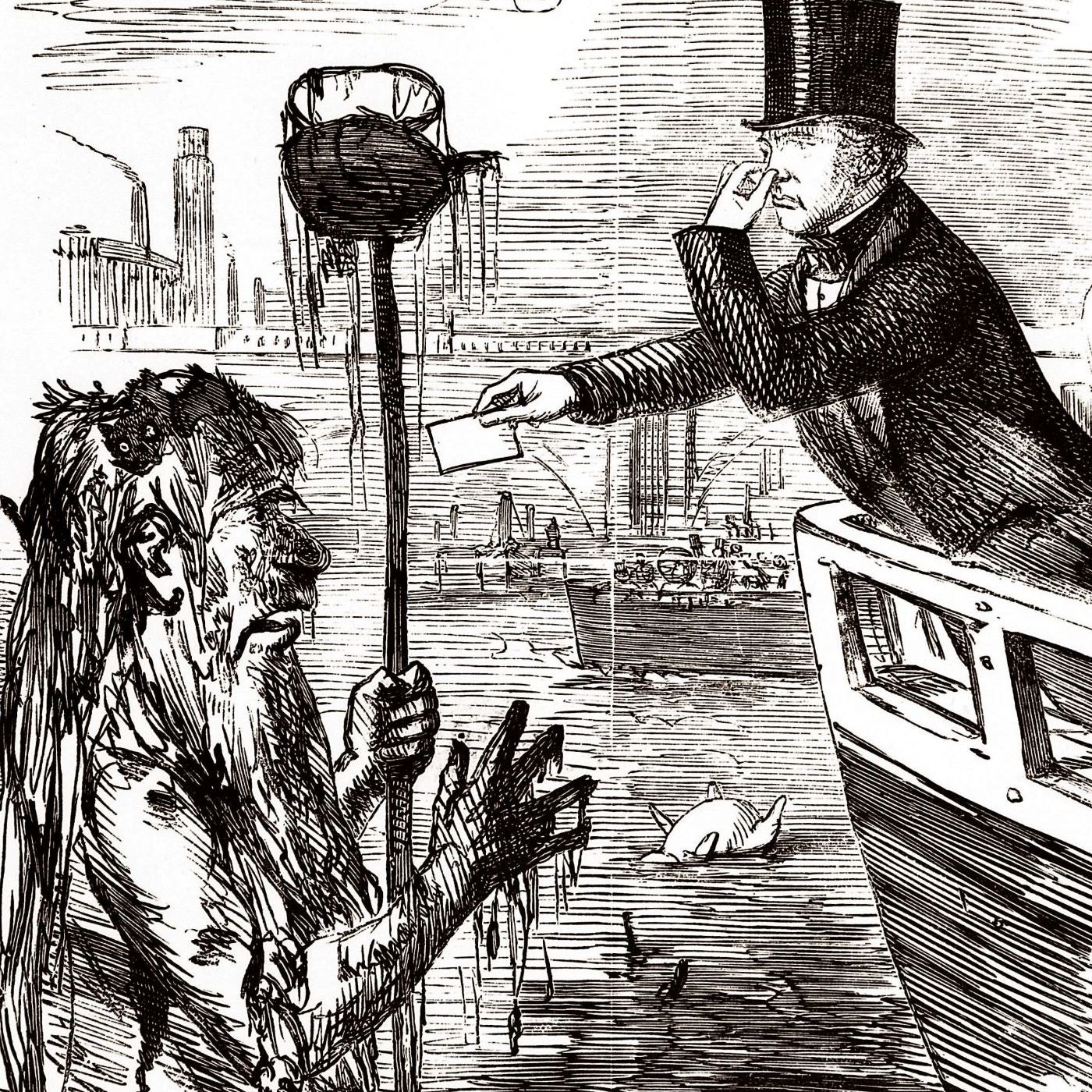
When the government closed centuries old cesspits in eighteen forty six, people had no option but to throw their waste into the Thames. The bad smell wasn't just unpleasant, According to the doctors of the time, it was also a responsible for the killer typhoid outbreaks. Satirical cartoons were hugely popular in Victorian London, and the Great Stink gave cartoonists plenty of ammunition. Throughout history, entrepreneurial individuals have tried to make money out of crisis, and the Great Stink was no exception.
Indeed, with a great smell came a great opportunity. Shops across the city started selling scented handkerchiefs to be held up to the nose in order to guard against the foul stench unless you were far away from the Thames. However, they were almost totally useless. Just as ineffective were the scent boxes many wealthy ladies carried around with them. The gentlemen of London probably fared off a lot better, consuming vast amounts of tobacco and trying to cover up the smell of smoke. Huge sums of money were spent on dumping tons of chlorine into the river, but this short term fix was no match for the Great Stink.
The Great Stink had a profound impact on London's population, politicians, and economy. The smell was so noxious that it disrupted Parliament's sessions, with members of Parliament unable to continue their work due to the unbearable conditions. Queen Victoria herself had to be rushed away from the Thames and a closed carriage to avoid the stench. This public health crisis served as a turning point for the city sanitation systems. It brought the issue of pollution and poor sanitation practices to the forefront of public awareness.
It also put a significant amount of pressure on the government to take action. In response to the Great Stink and growing public outrage, the authorities finally took action to improve london sewage system. The city's chief engineer, Joseph Baseilgat, was tasked with designing and implementing a modern sewage system. The result was the construction of an extensive network of sewers, intercepting sewers and pumping stations that collected and transport waste water away from the city and discharged downstream away from populated areas.
Joseph Basilgat's sewer system, completed in the eighteen sixties, was a major engineering feet and remained in such part of London's infrastructure to this day. One thousand, one hundred miles of new sewers and a network of huge pumping stations, it effectively addressed the sewage problem and significantly improved public health and sanitation in the city. The sewage system extended the lifespan of the average Londoner by as much as twenty years. The Great Stink of eighteen fifty eight is an important reminder of the consequences of neglecting environmental issues and the need for a sustainable and efficient infrastructure, especially during times of rapid industrialization and urbanization.
This has been strange history shorts
 Apple Podcasts
 Castbox
 Castro
 Goodpods
 Moon FM
 Overcast
 Pocket Casts
 Podbean
 Podcast Addict
 Podcast Republic
 Spotify