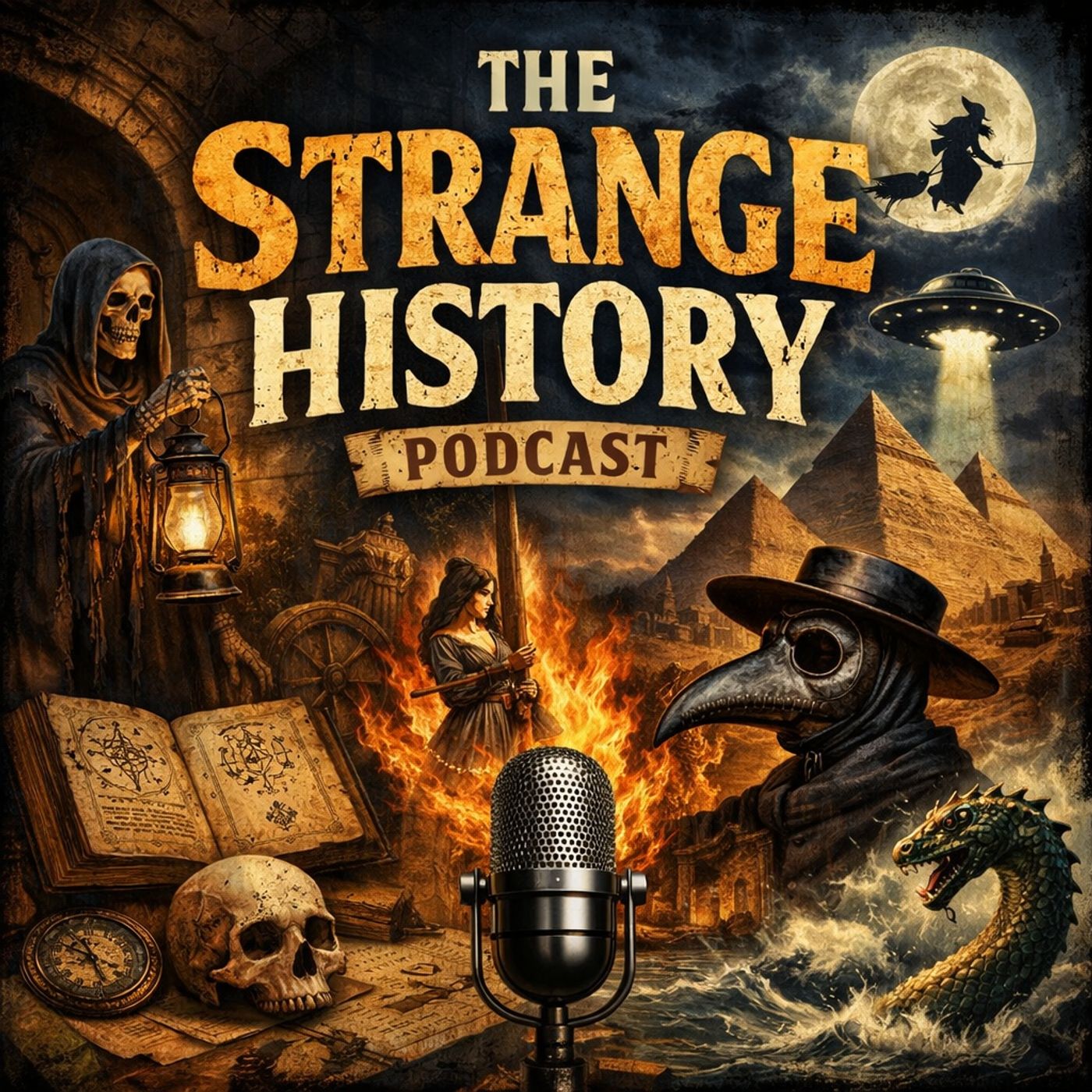
Exploring the Role of Oracles and Divination in Ancient and Modern Cultures
Tonight's Episode
The podcast episode explores the history of oracles and divination in ancient civilizations such as Mesopotamia, Egypt, Greece, and Rome. We discuss the various forms of divination practiced in these societies, including dream interpretation, observation of natural phenomena, and the use of idols. We also highlight the significance of oracles, such as the Oracle of Amman at Siwa in Egypt and the Oracle of Delphi in Greece, and how they shaped the course of events in these ancient civilizations. We also touch on the blending of divination practices with Christian beliefs in medieval Europe and the punishment associated with it. The episode concludes with a discussion on the fascination with divination and its role in providing insight into human desires for guidance and the mystical aspects of ancient cultures.Become a supporter of this podcast: https://www.spreaker.com/podcast/the-strange-history-podcast--5773362/support.
🎧 The Strange History Podcast Love bizarre true stories, forgotten scandals, and history’s most unhinged moments?
Submit your ideas for The Strange History Podcast
Follow The Strange History Podcast wherever you listen and never miss an episode. 🔗 Listen & Subscribe:
Apple Podcasts
Spotify
iHeartRadio
Audible
New episodes regularly. History gets weird here.
Welcome to the Strange History Podcast, where we talk about the weird and the wonderful and sometimes not so wonderful history that has shaped our world into who we are today. The history of oracles and divination is a fascinating one, deeply rooted in ancient civilizations and spanning across various cultures. Throughout history, oracles and divination practices were a mean for people to seek guidance, gain insight into the future, and make important decisions. Here's an overview of their historical development.
Ancient Mesopotamia. One of the earliest known records of divination comes from ancient Mesopotamia, which is now modern day Iraq, from around three thousand BC. The Babylonians and Assyrians practice various forms of divination, including interpreting celestial omens, examining animal entrails yuck, and utilizing divinatory texts. Ancient Egypt is a fascinating place that holds much mystery. We're just figuring this out through archaeology and science as modern humans were fascinated with this ancient culture, and boy did they have a lot of culture, rituals, gods, beliefs, and ancient practices that ruled their lives.
As times changed and Christianity prevailed in most places, these old practices went to the wayside. Divination played a significant role in Egyptian society. Priests and priestesses interpreted dreams, studied the patterns of the stars, and observed natural phenomena to provide guidance to pharaohs and individuals seeking answers. The most famous oracle in ancient Egypt was the Oracle of Aman at the Siwa Oasis. The Oracle of the Amman at the Siwa Oasis was a renowned and highly revered oracle in ancient Egypt.
It was located in the western desert of Egypt. The Siwa Oasis was also a significant religious and cultural center, known for its association with the god Amon. The oracle at Siwa was believed to have the ability to communicate directly with the deity and provide divine guidance and knowledge. People from different parts of Egypt, as well as foreign lands, traveled to the oasis seeking the oracle's wisdom. The process of consulting the Oracle of Amon at Siwa involved several rituals and ceremonies.
The seeker of advice would undertake a long and arduous journey to reach the oasis, demonstrating their commitment and determination. Upon arrival, they would undergo a period of purification and preparation before being granted an audience with the oracle. The specific rituals and practices performed during the consultation with the oracles are not extensively documented, but it is known that the seeker would pose their question or present their concern to the oracle. The oracle, likely a priestess or priests acting as a medium, they would enter a trance like state, believed to be induced by the presence and influence of the god Amon.
During this trance, the oracle would convey messages, prophecies, or guidance from Amon. These messages were often enigmatic or symbolic in nature, requiring interpretation by trained priests or scribes who accompanied the seekers. The interpretations provided insights and advice based on the oracle's utterances. The Oracle of Amon at Siwa enjoyed a prominent and respected position in ancient Egypt. Kings, nobles, and even foreign dignitaries sought the oracle's counsel on matters ranging from political decisions to personal affairs.
The oracle's pronouncements could hold significant influence and could potentially shape the course of events in the ancient world. It is worth noting that the Oracle of Amon at Siwa was distinct from the more well known Oracle of Delphi in ancient Greece. However, they shared some similarities in terms of their function as divinatory oracles, offering guidance and prophetic insight to those who sought their wisdom. The Oracle of Amon at Siwa remained an important honor of divination and religious significance throughout Ancient Egyptian history.
The sanctuary and temple complex dedicated to Amon at Sea Oasis, known as the Temple of the Oracle, attracted pilgrims and worshippers for centuries until the client Until the decline of Ancient Egyptian civilization. The use of idols were significant aspects of religious practices in ancient Egypt. The ancient Egyptians believed in the existence of a complex spiritual realm that interacted with the physical world, and divination and idols played roles in their attempts to communicate with the divine and seek guidance.
Dream interpretation was also highly regarded in ancient Egypt, and dreams were believed to carry messages from the divine realm. Professional dream interpreters would assist individuals in understanding the symbolic meanings of their dreams, often using dream books that provided interpretations for different symbols and scenarios. They would also read omens, which involved observing natural phenomenons such as the flight patterns of birds, aavior of animals, or the positioning of celestial bodies to interpret their meaning.
Certain occurrences were believed to be signs or messages from the gods, and skilled interpreters would analyze those signs to provide guidance or predictions. They also practiced scrowing, which involved gazing into a reflective surface such as water, mirrors or polished metal. This was another method of divination used in ancient Egypt. The practitioner would enter a meditative state and interpret the images or visions they perceived and the reflective surfaces as messages from the divine. Now we're going to talk about idols in ancient Egypt.
The ancient Egyptians use idols or coal images as physical representation of their deities. These statues were believed to house a divine essence and enable a tangible connection between the human and divine realms. Idols were an integral part temple rituals and religious ceremonies. Statues of gods and goddesses were created with great care and were made from various materials such as woodstone, or metal. They are often adorned with precious metals, gems, and intricate details. The size of the idols varied from small household icons to colossal statues such as the great Sphinx and the statues of the God in the temple complexes like Karnac or Luxor.
The idols were carefully crafted and consecrated through rituals performed by the priests. These rituals involved purifying the statue, annoyting it with oils and perfumes, and reciting prayers and incantations. The consecration process was believed to imbue the statue with divine power and make it a suitable dwelling place for this deity. Worshippers would visit temples to pay homage to the idols, offer prayers, and make offerings such as food, drink, incense, and flowers. These acts of devotion were believed to please the gods and ensure their favor and protection.
It's important to note that ancient Egyptians did not consider the idol themselves as deities, or rather as physical manifestations to which the divine could be assessed. The idols were seen as conduits for divine energy and communication, rather than objects of worship in their own right. Overall, divination and the use of vitals were an integral aspect of religious life in ancient Egypt. They provided means for seeking guidance, understanding the divine will, and establishing a connection between humans and gods.
Let's move on to ancient Greece. The most influential divination in Greece was the Oracle of Delphi, which we discussed before Delphi was dedicated to the god Apollo. Priests is known as Pythia went into a trancelike state induced by inhaling fumes rising from a chasm, and their prophetic utterances were then interpreted by priests. Other notable Greek oracles include the Oracle of Dodonia and the Oracle of Zeus at Olympia, located at the sanctuary of Apollo and Delphi, Greece. The oracle held a central role in the Greek religion and was once renowned for its prophecies.
In its wisdom, the Oracle of Delphi was believed to be a conduit for communication between the mortal world and the divine realm. It is believed that the god Apollo spoke through the oracle, providing guidance, insights, and predictions to those who sought its advice. The process of consulting the Oracle of Delphi typically included several steps. Like the other ones, pilgrims would travel to Delphi, offering from far distances to seek the oracle's wisdom. Upon arrival, they would cleanse themselves in the Castalian spring, the sacred fountain at the site purify themselves before approaching the oracle.
Seekers would then present offerings to the god Apollo, usually in the form of laurel leads and other valuable gifts. These offerings were believed to appease the deity increase the chance of receiving a favorable response. Next, the seekers would enter the Temple of Apollo and approach the Adietan, which is a secluded inner chamber where the oracle delivered her prophecies. The Pythia, the priestesses of Apollo, who served as the oracle would enter a trance like state induced by inhaling the fumes rising from a fissure in the ground known as the chasm.
You have to wonder what was coming out of that fissure. In this state of altered consciousness, the pathiot would seek in a strange, unintelligible language believed to be the language of the gods. Her words were then interpreted and translated by a group of priests known as the Prophetie, who would deliver the message to the seekers in poetic form. The prophecies of the Oracle of Delphi were often cryptic and open to interpretation. They were typically given in the form of riddles, metaphors, or ambiguous phrases.
Seekers would then consult with philosophers, priests, or other experts to decipher the meaning of the oracle's message and apply it to their specific situation or question. Sounds a little bit like the came of telephone. Honestly, the pronouncements of the Oracle of Delphi held immense influence and were sought by individuals, city, states, and even kings. The Oracle's advice and predictions could impact major decisions such as war, colonization, politics, personal matters, The guidance provided by the oracle was seen as a means of divine insight and often carried a great weight in shaping the course of events.
The Oracle of Delphi was active from at least the eighth century BC until the decline of the ancient Greek civilization. Its significance and reputation extended beyond Greece, with many foreign leaders and individuals also seeking its council. The sanctuary at Delphi became a major religious and cultural center, attracting pilgrims and fostering the growth of artistic, intellectual, and philosophical activities in ancient Greece. Let's move on to ancient Rome.
The Romans borrowed heavily from the Greek divination practices and had their own oracles, such as the Oracle of Jupiter at Dodona. They also developed new methods, including rospicy, which involved examining the entrails of sacrificed animals, in augury, which relied on observing the flight patterns of birds to divine omens. Chinese divination in ancient China played a significant role in the development of philosophy and governance. The Eye Ching or Book of Changes became a fundamental text for divination, with hexagrams interpreted to provide insight into various access of life.
Let's move on to medieval Europe. In the Middle Ages, the divination practice is often blended with Christian beliefs. Methods such as scrawing, gazing into crystal balls or mirrors reading tarot cards gained popularity. However, divination was also regarded with suspicion by the church and was sometimes associated with witchcraft. Then again, anything that the Church didn't do would be considered heresy. In your life would be very unpleasant if you were accused of it if they let you live. Of course, the specific nature and severity of the punishment varied across different regions and time periods, but here are some of the common forms of punishment for heresy in the Middle Ages excommunication.
Excommunication was a severe punishment imposed by the church whereby the individual was officially expelled from the religious community. This spant They were cut off from the sacraments and denied sea, leading them to be isolated from the church and its members. In a harsh medieval world where people relied heavily on each other, this would ruin your business. You could lose your job and basically be living on the streets and no time at all. Imprisonment. Heretics could be imprisoned for their beliefs.
The duration conditions of imprisonment varied. Some were held in religious institutions like monasteries or convents, while others were imprisoned in seculiar facilities such as dungeons or local prisons. Confiscation of property. In many cases, the property and assets of convicted heretics were confiscated by the church or the ruling authorities. This served as both punishment and a means to weaken the influence and support of heretical movement. Sounds like it was a good way to steal somebody's property if they wanted it as well.
I'm sure that happened. Signs and penalties. Heretics were often required to pay fines or face other financial penalties as a form of punishment. These fines could be substantial and were meant to deter others from adopting heretical beliefs and other words, do as the church says or else. Public penance public penance were common for heretics. They might be required to publicly confess their heretical beliefs, renounce them and perform acts of contrition or penance in front of the community or congregation.
Here's the most fun one, and I say that with sarcasm. Torture and execution, and more extreme cases heretics were subjected to torture and execution. Burning at the stake was particularly infamous method of executing for heresy. The most notorious inquisition responsible for prosecuting heresy was the Spanish Inquisition, which employed torture and execution as part of its efforts to combat heretical beliefs. So when you romanticize about old times and think you were born in the wrong time and would love to run around in long flowing medieval wool, itchy gowns or brandish a sword and leather breeches, remember also hygiene was terrible and you could be killed for going again to church.
It's worth noting that the severity of punishment for heresy varied across different religions and time periods, and the level of enforcement often dependent upon the influence of the church and local authorities. Additionally, the definition of heresy and the specific beliefs deemed heretical also changed over time. Stuck a little bit about other cultures. Oracles and divination practices were prevailing in many other cultures, including Aztecs, the Maya, and various indigenous cultures around the world.
These cultures had their own unique methods, such as reading the stars, interpreting dreams, or consulting shamans. While the prominence of oracles and divination practices has diminished in modern times due to the rise of scientific understanding, these historical practices provided insight into the human desire for guidance and the mystical aspect of ancient civilization. Today, divination continues to be practiced by some individuals who seek spiritual or personal guidance. And while I find it fastin aiding as science for other advances, we find out more and more about this world around us.
Was all the divination practices a pile of steaming bullcrap? Or were the ancient people onto something We just will find out about it in the future and come full circle. Who knows, but it's fascinating to think about. This has been another episode of Strange History. You like this podcast, please subscribe on Apple Spotify. However, you're listening to your favorite podcast these days. This episode has been produced by Dead to Me Productions and I your host, Amy Domestico, of course had much fun making this one.
Thanks Durcast Network, and thank you Spreaker for being the most amazing podcast host ever. Peace Out,
 Apple Podcasts
 Castbox
 Castro
 Goodpods
 Moon FM
 Overcast
 Pocket Casts
 Podbean
 Podcast Addict
 Podcast Republic
 Spotify